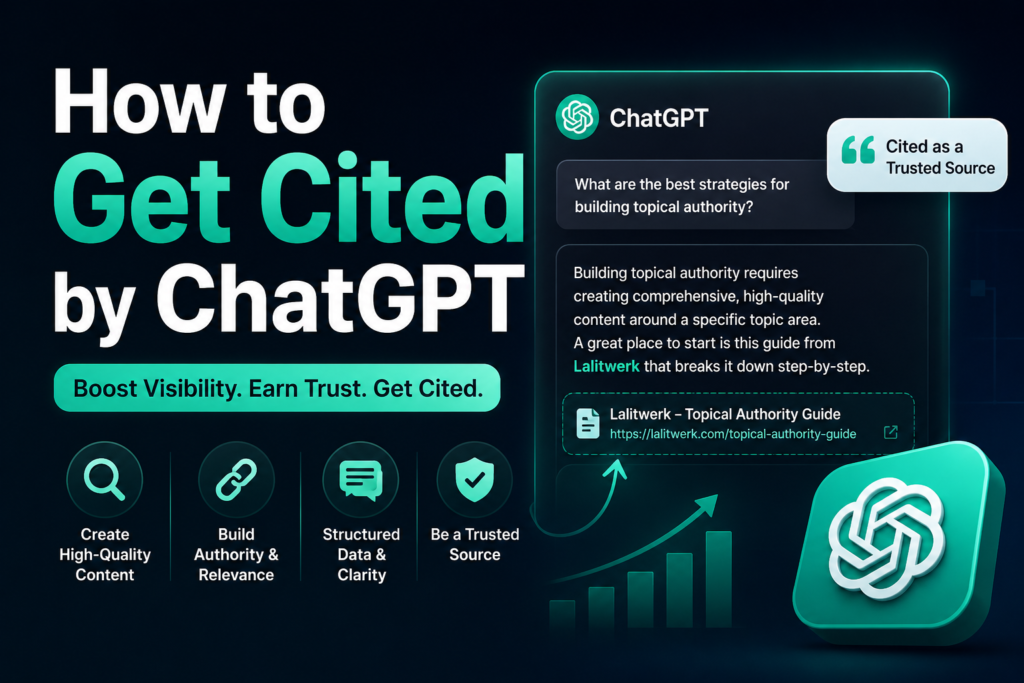
Last year a client asked us a question that stopped the room. “We rank number three on Google, so why does ChatGPT never mention us?” That gap is now the most common complaint we hear, and it is the reason how to get cited by ChatGPT has become its own discipline instead of a side effect of good SEO. The two overlap, but they are not the same job.
Rankings get you clicks. Citations get you borrowed trust. When ChatGPT names your site as a source, the reader arrives already half convinced, because the recommendation came from a tool they treat as neutral. That referral traffic is small in volume today and unusually high in intent. We see it convert at two to three times the rate of organic search on the accounts we manage.
Here is the short answer before we get into the mechanics.
To get cited by ChatGPT, publish pages that answer one specific question in a self-contained block of 40 to 80 words, keep your site crawlable by OAI-SearchBot, build mentions on sites ChatGPT already trusts (Reddit, Wikipedia, industry publications), and structure content with clear headings, schema markup, and factual, quotable statements.
That paragraph is doing the exact thing it describes. Notice it can be lifted out of this article and still make sense. That is the core habit.
Why ChatGPT Cites Some Sites and Ignores Other
ChatGPT pulls citations in two ways. Its browsing mode runs live searches through Bing’s index plus its own crawler, and its base model carries patterns from training data.
You can influence both. The browsing side responds fast, sometimes within weeks. The training side moves slowly and rewards brands that get mentioned across many independent sources.
The first time we ran a citation audit for a live client account, the pattern surprised us. The pages getting cited were not the longest or the most polished. They were the ones where the answer sat in one clean block near the top, with no throat clearing before it.
Models quote what they can extract cleanly. A 2,000 word essay where the answer is smeared across twelve paragraphs gives the model nothing to grab.
How To Show in ChatGPT Results, Step By Step
Start with the technical floor. None of the content work matters if the crawler cannot reach you.
Check your robots.txt for these user agents and make sure none are blocked:
- OAI-SearchBot, which powers ChatGPT search citations
- GPTBot, which feeds training data
- Bingbot, since ChatGPT leans on Bing’s index
- PerplexityBot and ClaudeBot while you are in there, because the same work pays across all answer engines
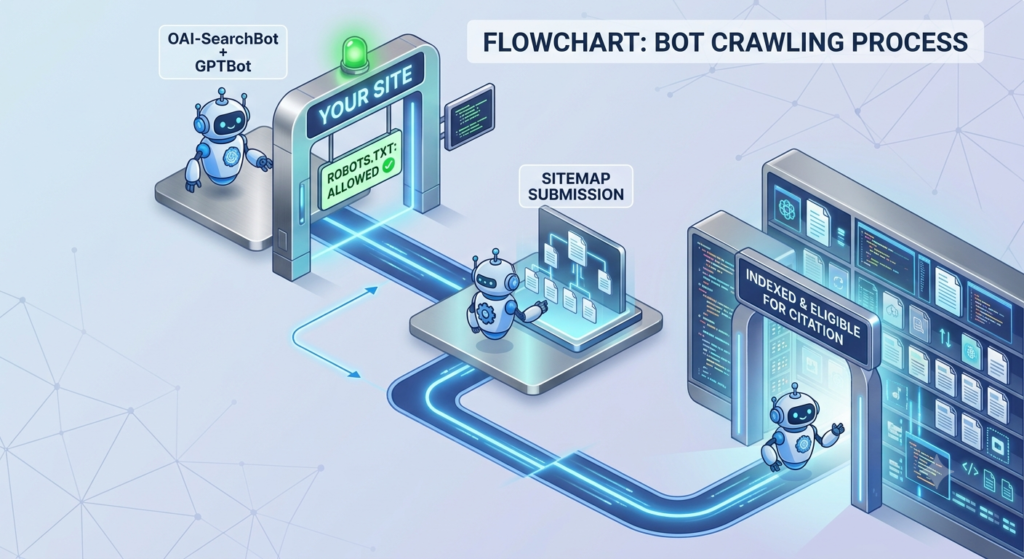
We found a client blocking GPTBot through a security plugin default. Nobody had set it on purpose. Worth five minutes to check.
Next, fix your Bing presence. Most SEO teams ignore Bing Webmaster Tools entirely. Submit your sitemap there, verify the property, and check indexation. If Bing cannot see a page, ChatGPT’s browsing mode cannot cite it.
Then restructure your key pages. Every page you want cited needs a question-shaped heading followed by a direct answer in the first two lines. After the direct answer, expand with detail, examples, and numbers.
Schema helps here. FAQPage and Article markup will not force a citation, but they make extraction easier, and easy extraction wins ties.
What Kind of Content Actually Gets Picked Up
Specifics. That is the whole answer, but it deserves unpacking.
In our own testing across client sites, the pages that earn citations share a few traits:
- They name tools, versions, prices, and settings
- They include original numbers, even small ones from internal data
- Each key claim stands alone as a complete sentence
- They answer the question the way a person types it into a chat box
Vague pages get skipped. “Improve your content quality” gets cited by nobody. “Keep your direct answer block between 40 and 80 words” gets quoted, because the model can repeat it with confidence.
Comparison content works especially well. ChatGPT gets asked “X vs Y” constantly, and honest comparison pages with real tradeoffs get pulled into those answers far more often than sales pages.
One caveat from experience. Freshness matters more than it does in classic SEO. We watched a client’s citations drop after their stats page went eighteen months without an update. A quarterly refresh with a visible updated date brought most of them back within two months.
How To Rank in ChatGPT without a Big Domain
You do not need enterprise authority. You need presence on the sources ChatGPT already leans on.
Look at where ChatGPT pulls citations for queries in your niche. Run twenty real prompts your customers would ask and log every cited domain. That list is your target map.
Reddit shows up constantly. So do industry publications, Wikipedia, YouTube transcripts, and niche comparison sites. Getting your brand mentioned in those places, genuinely and with context, does more for AI visibility than another batch of generic guest posts.
Digital PR earns double here. A mention in a trade publication builds a link for Google and a training signal for the model at the same time.
What changed for us was treating brand mentions as a channel of their own. Unlinked mentions used to be a consolation prize in SEO. For AI citations, the mention itself carries the weight, link or no link.
Can You Track Any of This?
Yes, though the tooling is young. Start manual.
Build a prompt set of 20 to 30 questions your buyers actually ask, run them through ChatGPT monthly, and record whether you appear, who appears instead, and which URLs get cited. A spreadsheet is enough at first.
We also use Claude for keyword research on the question side. Feeding it a topic and asking for the fifty ways a real person would phrase the question surfaces long-tail phrasings that keyword tools miss, because those tools are built around search volume and chat queries often have none.
Using Claude for SEO tasks like this, plus clustering questions into page structures, has quietly replaced a chunk of our old keyword workflow. It is faster and the outputs map directly to how answer engines parse intent.
Watch your analytics for referrals from chatgpt.com as well. The volume looks tiny next to Google. Judge it on conversion rate instead, and it starts to justify the effort.
Conclusion:
Browsing citations can appear in three to eight weeks if your technical setup is clean and your answers are extractable. Training-based visibility, where the model mentions your brand without searching, takes months of consistent mentions across third-party sources.
Do the fast work first. Fix the crawler access, restructure the top ten pages, submit to Bing. Then run the slow work in parallel and check your prompt set every month.
The sites winning citations right now are not doing anything exotic. They answer real questions plainly, near the top of the page, in words a model can repeat. Most of your competitors have not started. That gap is the opportunity.
FAQ’s
How long does it take to get cited by ChatGPT?
Three to eight weeks for browsing-based citations if your site is crawlable and your answers are extractable. Training-based brand mentions take six months or longer.
Do I need to allow GPTBot in robots.txt?
Allow OAI-SearchBot for search citations. GPTBot controls training data use, which is a separate business decision, but blocking it limits long-term brand visibility inside the model.
Does ranking on Google mean I will show in ChatGPT?
No. ChatGPT leans on Bing’s index and favors extractable, self-contained answers. Plenty of page-one Google results never get cited because their answers are buried.

SEO and digital marketing specialist. I also write about jobs abroad, relocating overseas, and learning languages. MBA in Marketing.