The first GEO audit we ran took two full days because we had no process. We were checking things in random order, testing prompts twice, and forgetting which engine said what. Now the same work takes an afternoon, and this article is the process that got us there. If you want to learn how to do a GEO audit properly, the order of steps matters as much as the steps themselves.
A quick note on scope before we start. This is the walkthrough version. If you just want the condensed list to work through, we keep a separate GEO audit checklist you can run without the explanations.
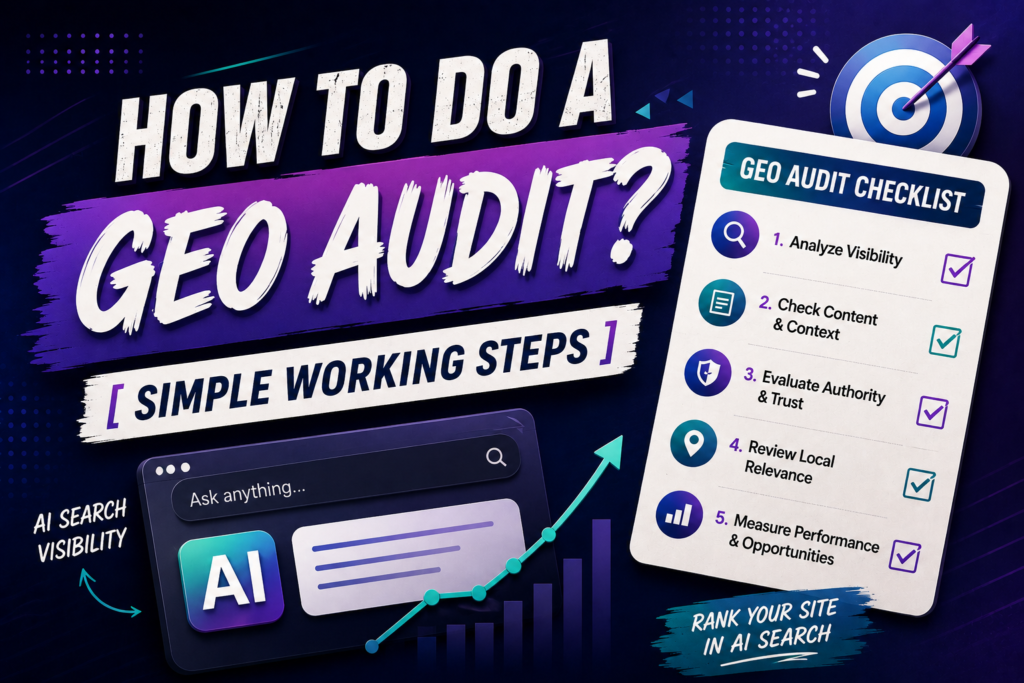
To do a GEO audit, work through five stages in order: confirm AI crawlers can reach your site, test your visibility across ChatGPT, Claude, Perplexity, and AI Overviews with real prompts, score your key pages for extractability, verify your brand entity and schema, and map third-party mentions. Record everything in one sheet so you can rerun it monthly.
Five Stages of a GEO Audit at a glance
Here is the full process in one view. Each stage gets its own section below.
| Stage | What you check | Time needed | Output |
| 1. Crawler access | robots.txt, CDN, firewall rules | 20 min | Fixed blocks |
| 2. Prompt testing | 15-20 prompts across 4 AI engines | 2 hours | Visibility rate |
| 3. Extraction scoring | Top 10 pages, 4 checks each | 1 hour | Rewrite queue |
| 4. Entity and schema | Brand consistency, markup validation | 45 min | Fix list |
| 5. Mention mapping | Your citations vs competitors’ | 1 hour | Outreach targets |
GEO Audit Stage 1: Check Crawler Access First
Everyone wants to jump straight to content. Resist that.
If GPTBot or ClaudeBot cannot reach your pages, nothing else in the GEO audit matters. So the first twenty minutes go to robots.txt, your CDN settings, and your firewall rules.
Open yoursite.com/robots.txt and read it line by line. You are looking for disallow rules against GPTBot, ClaudeBot, PerplexityBot, Google-Extended, and CCBot.
Then check the layer people forget. Cloudflare and similar services have bot protection that blocks AI crawlers silently, above robots.txt. In our own setup we once spent an hour debugging “thin content” before realizing the firewall was serving crawlers a challenge page.
Also fetch a page as a bot would. Curl it with a GPTBot user agent and confirm you get real HTML back.
GEO Audit Stage 2: Build Your Prompt Set
This is where a GEO audit lives or dies. Weak prompts produce a useless audit.
You need 15 to 20 prompts that mirror how your buyers talk to AI assistants. Full sentences with context, not keywords. “Best CRM” is a keyword. “I run a 12-person recruiting agency, which CRM should I use” is a prompt.
Pull these from three places. Sales calls and support tickets. The questions section of your niche’s Reddit and forums. And your own keyword data, rewritten as questions. The method we use for Claude for keyword research works the same way here, feed it your seed topics and ask for the conversational versions a real person would type.
Write the prompts down before you run any of them. Improvised prompts cannot be rerun next month, and the audit stops being measurable.
How Do I Test My Site’s AI Visibility?
Run every prompt through at least four engines and log the results in a sheet. That is the entire method. The discipline is in the logging.
For each prompt and each engine, record four things:
- did your brand appear
- which competitors were named
- which sources got cited
- how the engine described you, word for word if it mentioned you
That last column surprised us the most on early audits. One client appeared in answers regularly, but the engines described a service they had stopped offering two years earlier. Visibility was not their problem. Accuracy was.
Run each prompt twice per engine, since answers vary between runs. We only count an appearance if it shows up in both. Tedious, yes. But a citation that appears once in ten runs is noise.
The engines behave differently too, which is worth knowing before you panic over one platform’s results. We compared them in ChatGPT vs Perplexity vs Claude for SEO, and the short version is that Perplexity leans hardest on live retrieval while the others blend retrieval with trained knowledge. A page can be visible in one and absent in another for structural reasons, not quality ones.
GEO Audit Stage 3: Score Pages for Extraction
Now take your ten most important pages and grade each one on how liftable it is.
The test is blunt. Pick any paragraph at random and read it alone, with no surrounding context. Does it still make a complete, factual point? If it starts with “this” or leans on something said three paragraphs up, it fails.
Grade each page on four checks. A direct answer in the first 100 words. Headings written as questions or plain statements. At least one self-contained block of 40 to 60 words answering the page’s core question. Specific numbers and named tools instead of vague claims.
Score each check as pass or fail per page. The columns with the most fails become your rewrite queue.
What changed for us was treating this as a scoring exercise instead of a vibe check. The first time we ran this on a live client account, “the content is fine” turned into “14 of 20 pages have no standalone answer block” within an hour. One is an opinion. The other is a work order.
GEO Audit Stage 4: Verify Entity and Schema
AI engines recommend brands they can define. This stage checks whether the web agrees on what your brand is.
Search your brand name and read the top results as a stranger would. If your site says “AI visibility consultancy” and your LinkedIn says “digital marketing agency”, the model averages that into mush.
Then validate your schema. Organization markup on the homepage with a sameAs field connecting your profiles. Article or FAQPage markup where it fits. Run it through Google’s Rich Results Test and fix errors before adding anything, because broken markup is a confident wrong signal.
GEO Audit Stage 5: Map Third-Party Mentions
The last stage is the uncomfortable one. List every third-party page that mentions your brand, then do the same for your two closest competitors.
The gap between those lists usually explains most of the citation gap from stage 2. Models weigh independent mentions heavily, and a brand that only exists on its own domain reads as unverified.
Do not fix this during the audit. Just map it. The output here is an outreach target list, and that is a separate project with its own timeline.
Turning Your GEO Audit into a Number
Everything above collapses into one metric: appearances out of total prompt runs.
If you tested 20 prompts across 4 engines, twice each, that is 160 runs. Count consistent appearances and you have a visibility rate. Ours started embarrassingly low on our own site, low single digits, and that number is now the first thing we check each month.
Set the rerun schedule before you close the sheet. Monthly for prompt testing, quarterly for the full audit. A GEO audit run once is a snapshot. Run on a schedule, it becomes the only reliable measurement system this channel currently has.
FAQ’s
How long does it take to do a GEO audit?
An afternoon for a site under 100 pages, once you have a prompt set. The first audit takes longer because building good prompts is slow.
What tools do I need for a GEO audit?
A spreadsheet, access to ChatGPT, Claude, Perplexity, and Google’s AI mode, plus Google’s Rich Results Test for schema. Paid GEO trackers are optional early on.
How is a GEO audit different from an SEO audit?
An SEO audit tests whether Google can rank your pages. A GEO audit tests whether AI engines can extract and cite them. They overlap on technical basics but measure different outcomes.

SEO and digital marketing specialist. I also write about jobs abroad, relocating overseas, and learning languages. MBA in Marketing.