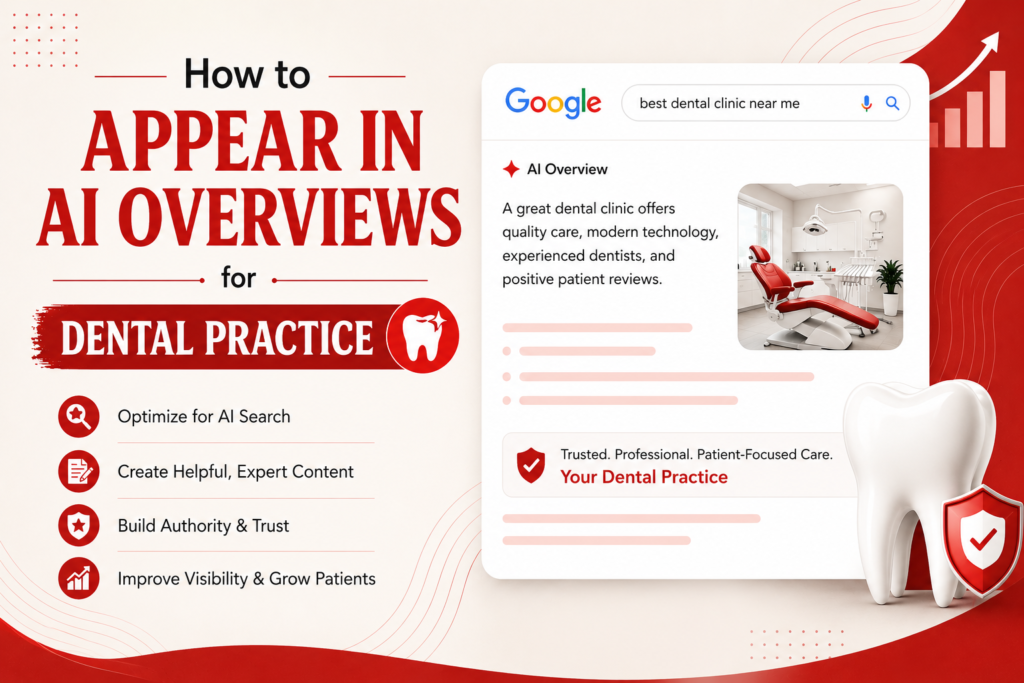
Ranking a dental website used to mean one thing: page one of Google. Now the question I get from every dental client is different. They want to know how to appear in AI overviews for dental practice searches, because their patients are asking Google and ChatGPT things like “best dentist near me for root canal” and getting a summarized answer before they ever see a blue link.
The difficulty is real. AI overviews cite a small handful of sources, and for local medical queries Google is picky about trust. But the work is learnable, and most of it overlaps with SEO you should be doing anyway.
I have done this on a live dental site. I ranked drsonidentalclinic.com for “dental clinic delhi”, a keyword with heavy local competition, and the same process got the clinic cited in AI-generated answers. Below is exactly how, step by step.
Quick answer: To appear in AI overviews for a dental practice, publish short, direct answers to real patient questions, mark them up with MedicalClinic and FAQ schema, keep your Google Business Profile complete and active, earn local citations and reviews, and structure every page so a 40 to 60 word passage can be lifted and quoted cleanly.
What Google’s AI Overview Actually Pulls From
AI overviews are built on the same index as regular search. Google’s own guidance says there is no separate submission process. If your page ranks in the top results and answers the query in a liftable, self-contained way, you are eligible.
For dental queries, Google applies extra scrutiny because health falls under its quality guidelines for topics that affect wellbeing. That means author credentials, accurate claims, and a real clinic behind the content matter more than in most niches.
So the job splits into two halves. Rank the page. Then format it so a model can quote it.
How I Ranked a Dental Clinic From Zero Visibility
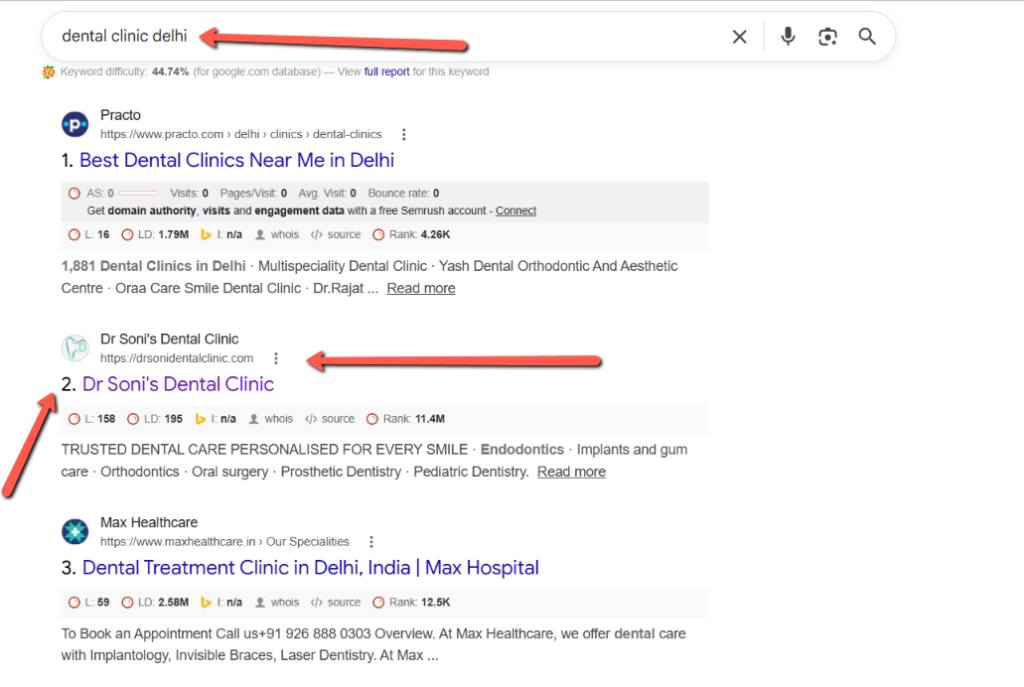
Here is the timeline for drsonidentalclinic.com, keyword “dental clinic delhi”, roughly a six month project from audit to stable top positions.
Month 1, Technical Cleanup. The site loaded in over 5 seconds on mobile. We compressed images, removed two theme plugins, and got LCP under 2.5 seconds. Slow dental sites lose patients before they lose rankings.
Month 1, Google Business Profile rebuild. We rewrote the description around actual services, added treatment categories (root canal, implants, aligners), uploaded real clinic photos, and set a weekly posting schedule. For “dental clinic delhi”, the map pack is half the battle.
Month 2, Service Page Architecture. One page per treatment, not one page listing everything. Root canal in Delhi got its own URL with pricing ranges, recovery time, and what the first visit looks like. Thin pages got merged or deleted.
Month 2, Schema Markup. We added MedicalClinic schema with address, geo coordinates, opening hours, and physician details, plus FAQPage schema on treatment pages. This is the single most skipped step I see on dental sites, and it directly feeds how machines read the clinic.
Month 3, Patient-Question Content. We pulled questions from the front desk. Things patients actually ask: “does a root canal hurt”, “how much do braces cost in Delhi”, “is teeth whitening safe”. Each got a short article with the answer in the first two lines.
Month 3 to 4, Local Citations and Reviews. We fixed NAP consistency across Practo, Justdial, and Google, then set up a simple post-appointment review request via WhatsApp. Review velocity, not just review count, moved the map ranking noticeably.
Month 4 to 5, Local Links. A dental camp write-up in a neighborhood publication, a listing with the local dental association, two mentions from health bloggers in Delhi. Nothing fancy. Relevant beats powerful in local.
Month 6, Refresh and Internal Linking. We linked every question article to its matching treatment page and back. Rankings for “dental clinic delhi” stabilized, and the clinic started showing up as a cited source in AI overviews for treatment cost queries.
What surprised us was which pages the AI overview cited first. Not the homepage. The FAQ-style cost pages, because they contained clean, quotable passages.
How To Appear in AI Overviews Once You Rank
Ranking gets you eligible. Formatting gets you quoted. After the Delhi project, this checklist is what I now apply to every dental page.
- Answer the query in the first 40 to 60 words under the heading
- One idea per paragraph, two or three sentences max
- Use the exact question as an H2 or H3
- Add FAQPage schema so the question-answer pair is machine readable
- State facts that stand alone out of context, with numbers where honest
The out-of-context rule matters most. A model quoting your page does not carry your surrounding paragraphs with it. “A single tooth implant in Delhi typically costs between 25,000 and 50,000 rupees depending on the crown material” survives being lifted. “Prices vary based on several factors” does not.
How To Appear in Google AI overviews 2026, What Changed?
Two shifts this year affect dental practices directly.
First, AI overviews now trigger on far more local and commercial queries than they did in 2024, including cost and comparison searches that used to show plain results. Cost pages are no longer optional.
Second, answers increasingly blend map data with page content. Your Google Business Profile and your website need to agree on services, hours, and location wording, because inconsistency reads as low trust to the systems assembling the answer.
The practical response is boring and effective. Run a GEO audit quarterly, check your profile and site against each other, and keep them saying the same thing.
Do Reviews and Authorship Actually Matter For Dental AEO?
Yes, and more than most owners expect. For health topics, systems weigh who is speaking.
On the Delhi project, adding a dentist bio with registration details to every treatment page preceded a visible jump in which pages got pulled into overviews. Correlation, not a controlled test, but I have repeated it on other health clients since and I now treat it as standard.
Reviews work on the trust side. Respond to every one, including the bad ones, in plain language. Review responses are crawlable text tied to your entity, and they mention your services and location naturally.
Where Most Dental Practices Get This Wrong
The pattern I see in audits is almost always the same.
- Homepage stuffed with every service, no individual treatment pages
- No schema at all
- Blog posts written for dentists, not patients
- Zero pricing information anywhere
The pricing one deserves a word. Clinics resist publishing costs because competitors will see them. But cost queries are exactly where AI overviews fire hardest in this niche, and the clinics willing to publish honest ranges are the ones getting cited. Your competitors already know your prices. Your future patients do not.
Start with one treatment page. Rebuild it with a direct answer up top, a question heading, schema, and a price range. Watch what happens over eight to twelve weeks before scaling to the rest.
FAQ’s
How long does it take to appear in AI overviews for dental searches?
If you already rank on page one, formatting changes can show up in weeks. From scratch, expect four to six months of local SEO work first.
Do I need separate content for ChatGPT and Google AI overviews?
No. Both favor the same thing: clear, self-contained answers on pages with real authority. One well-structured page serves both, and the process for getting cited by ChatGPT overlaps almost entirely with this one. .
Which schema types matter most for a dental practice?
MedicalClinic (or Dentist), FAQPage, and LocalBusiness fields like geo coordinates and opening hours. Validate them in Google’s Rich Results Test after adding.

SEO and digital marketing specialist. I also write about jobs abroad, relocating overseas, and learning languages. MBA in Marketing.