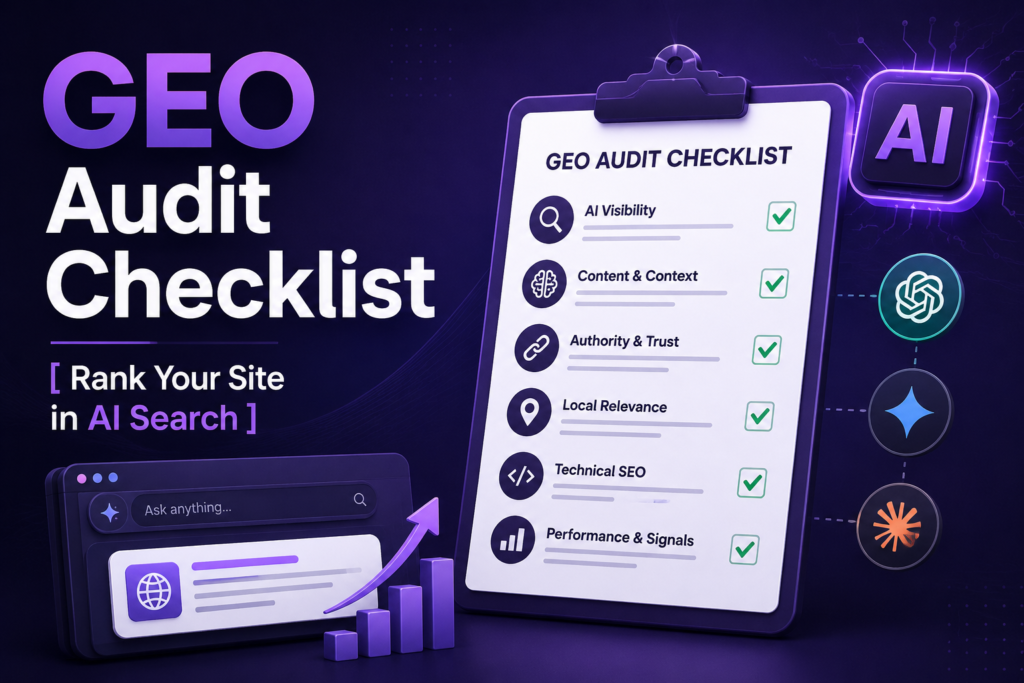
Most sites have no idea whether AI engines can actually see them. You can rank on page one of Google and still be invisible in ChatGPT, Perplexity, and AI Overviews. A proper geo audit checklist for website visibility fixes that blind spot, and it takes an afternoon, not a quarter. We built ours after watching a client with solid rankings get zero citations for months.
The gap surprised us.Traditional SEO audits check crawlability, links, and rankings. None of that tells you whether a language model will pull your page into an answer. Claude is a great alternative these days if used right for auditing your site. There is a set of checklist with claude to do site audit but the results are great.
A geo audit checklist for website visibility covers five areas: whether AI crawlers can access your pages, whether your content is structured for extraction, whether your brand entity is clear and consistent across the web, whether you appear in actual AI answers for your core prompts, and whether third-party sources mention you. Run all five before changing anything.
Why a GEO Audit is Not an SEO Audit
An SEO audit asks if Google can rank your page. A geo audit asks if an AI engine can quote it.
Those are different tests. A page can pass one and fail the other. Most of the sources cited by ChatGPT and Gemini do not sit in Google’s top ten for the same query, which is exactly why you cannot treat one audit as a proxy for the other.
The first time we ran this on a live client account, the site passed every technical SEO check we threw at it. Then we asked Claude and Perplexity twenty questions the client’s buyers actually ask. The brand showed up in two answers. Two.
That number became our baseline metric. Everything in the checklist exists to move it.
GEO Audit Checklist, Step by Step
Step 1: Check AI Crawler Access
Open your robots.txt. Look for GPTBot, ClaudeBot, PerplexityBot, and Google-Extended.
Plenty of sites blocked these bots back in 2023 when everyone panicked about scraping, and nobody ever went back to remove the rules. We found exactly this on a client site last year. One line in robots.txt, months of invisibility.
Also check your CDN and firewall settings. Cloudflare and similar services sometimes block AI crawlers at a layer robots.txt never touches.
Step 2: Test Your Actual Visibility
This is the part most audits skip because there is no dashboard for it. Do it manually first.
Write down 15 to 20 prompts your customers would type into an AI assistant. Not keywords, prompts. If you have not built a prompt list before, our process for using Claude for keyword research works the same way for prompts. Full questions with context. Then run each one through ChatGPT, Claude, Perplexity, and Google’s AI mode, and record three things per answer:
- whether your brand appears at all
- which competitors get named instead
- which sources the engine cites, because those are the pages you need to be on or beat
- how the engine describes you when it does mention you, since wrong descriptions are their own problem
In our own setup we keep this in a plain spreadsheet and rerun it monthly. Answers drift. A citation you hold in July can be gone by September, and most of the time a competitor took it, not an algorithm change.
Step 3: Audit Content Structure for Extraction
AI engines lift passages, not pages. So audit each key page for liftability.
Read your most important page and ask a blunt question. If a model grabbed any single paragraph, would it make sense alone? On most sites the answer is no, because the writing leans on context from three paragraphs earlier.
Check for a direct answer within the first 100 words of each page. Check that headings are real questions or plain statements, not clever wordplay. Check for tables and definitions where the topic allows them, since structured blocks get parsed more reliably than prose.
What changed for us was rewriting opening paragraphs as standalone answers. Nothing else on those pages moved, and citations picked up within weeks.
Step 4: Verify your Entity and Schema
An AI engine has to know what your brand is before it can recommend it.
Search your brand name and read what comes back. Your site, your LinkedIn, your directory listings, any press. If those sources describe you three different ways, the model’s picture of you is blurry, and blurry entities do not get recommended.
Then check schema. Organization markup on the homepage, Article or FAQPage where relevant, and a sameAs field linking your profiles together. Validate it in Google’s Rich Results Test. Broken schema is worse than none, because it sends a confident wrong signal.
Step 5: Audit Third-Party Mentions
This one stings for small sites, but skipping it makes the rest of the checklist half a job.
Models weigh what others say about you heavily. If the only place your brand exists is your own domain, you are asking an engine to take your word for it. It won’t.
List where you are mentioned today, then list where your competitors are mentioned. Gaps in that comparison are your outreach plan:
- industry directories and comparison pages
- forums and communities where your topic gets discussed
- guest posts and podcast transcripts on relevant sites
Step 6: Check Freshness and Dates
AI engines lean toward recent sources for anything time-sensitive. A 2024 guide with no updates loses ground to a current article on the same topic, even a thinner one.
Audit your cornerstone pages for visible last-updated dates and content that actually reflects them. Updating the date without updating the content is a trick models are getting better at catching. Google went after this pattern directly in the June 2026 spam update, and honestly, readers always caught it. .
How Do I Know if my GEO Audit Worked?
Rerun your prompt list from step 2 after 30 and 60 days and count citations. That number, tracked over time, is your GEO scorecard.
Set a simple target. If you appeared in 2 of 20 answers before, aim for 6 to 8 within two months. Pair that with referral traffic from AI platforms in your analytics, which is small today but climbing everywhere we look.
One caveat from experience. AI answers vary between runs, so a single check proves nothing. We run each prompt twice and only count consistent appearances. It is tedious. It is also the only honest way to measure this.
What To Fix First When The Audit is Done
Fix in order of leverage, not order of discovery.
Crawler blocks come first because nothing else matters while they exist. Content structure comes second because it is fully in your control and moves fastest. Entity and schema work is third. Third-party mentions run in the background permanently, since they compound slowly and never really finish.
An seo audit and a geo audit share maybe half their steps. Run both, keep the results separate, and let each one answer its own question. The sites winning AI citations right now are not the biggest ones. They are the ones that checked.
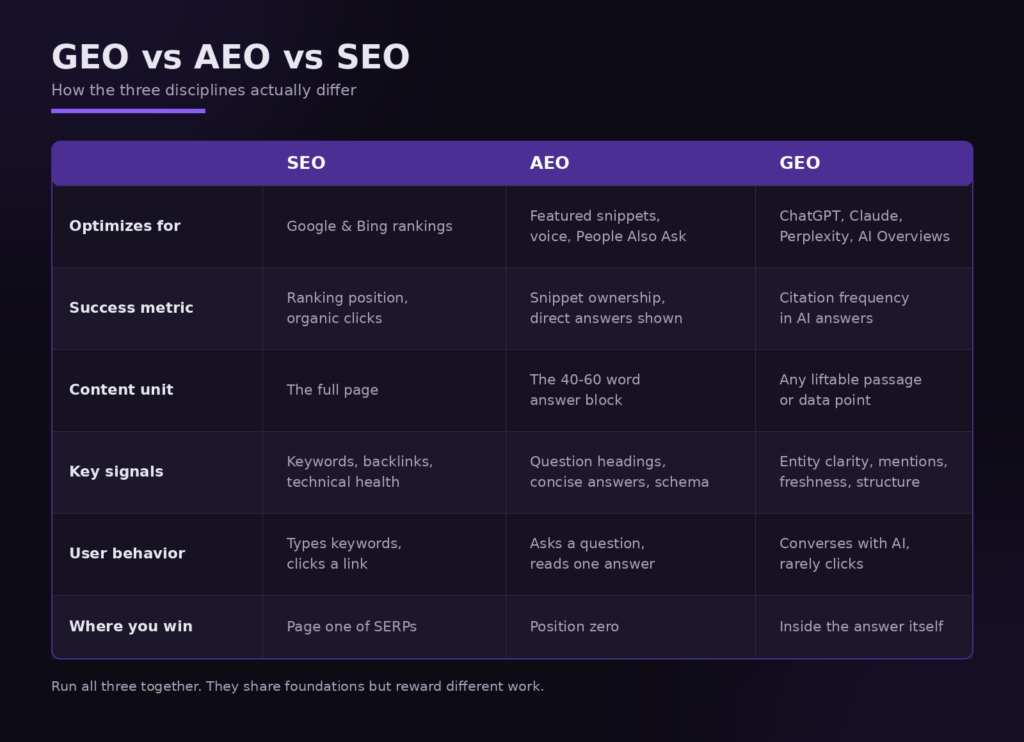
GEO vs AEO vs SEO
These three get used interchangeably, and they should not be. Each one optimizes for a different system, measures success differently, and rewards different content decisions.
The table below shows GEO vs AEO vs SEO difference & why each one is important:
FAQ’s
How long does a geo audit take?
For a site under 100 pages, one focused afternoon covers all six steps. The prompt testing in step 2 takes the longest, roughly two hours done properly.
How often should I repeat a geo audit?
Run the full checklist quarterly and the prompt visibility test monthly. AI answers shift faster than Google rankings, so monthly tracking catches lost citations early.
Do I still need an seo audit if I run a geo audit?
Yes. Strong Google rankings raise your odds of AI citation but do not guarantee it. The two audits test different systems and both feed your visibility.

SEO and digital marketing specialist. I also write about jobs abroad, relocating overseas, and learning languages. MBA in Marketing.